Computational infrastructure for autonomous platforms and mission systems.
The solver that doesn’t crash when sensor data turns adversarial. Digital twins that actually match the platform. Embedded math that runs the same on the workstation, the HIL rig, and the airframe — and an evidence base built to survive a program-office audit.
One computational engine. Eight mission domains it changes.
The same noise-stable solver, embedded-first design, and audit-grade evidence base show up across air, sea, space, sensors, sustainment, and program acceptance.
Air & Autonomy
GN&C math that survives the contested edge
Flight controllers, autopilots, and autonomy stacks are only as good as the math inside them. Our solver runs the same compiled binary in MATLAB, on a HIL rig, and on the airframe — and survives the kind of noisy, impulsive, non-stationary sensor data that breaks every other integrator at exactly the moment it matters.
SolvSRKSolvSRK-UQSolvNum
Sustainment & Readiness
Platform digital twins that actually match the platform
Predictive maintenance and fleet-readiness twins fail because the on-board model and the cloud model are different software. We collapse them into a single binary, so a divergence between the platform and its twin means a real fault, not a software artifact. Less alert fatigue. Fewer false-positive inspections. Higher mission-capable rate.
SolvSRKSolvNum
Sensors & Fusion
Recover the intelligence the link compression throws away
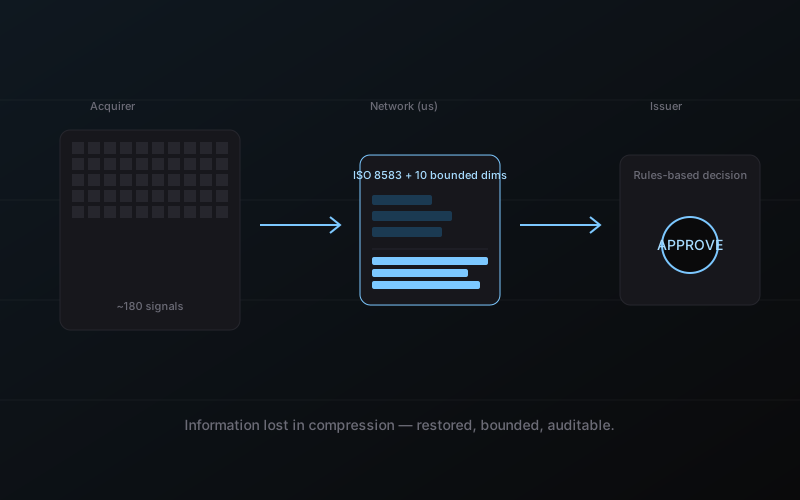
Tactical data links and sensor-fusion buses compress a rich upstream picture into a small standardized message. Moridain recovers bounded intelligence dimensions inside the existing message envelope — validated on a 590,540-event benchmark, ready to adapt to a representative data-link environment under appropriate agreement.
Targeting, mission planning, and clearance decisions all need to know how confident the math actually is. SolvSRK-UQ delivers calibrated uncertainty envelopes from a single solve — fast enough to sit inside an autopilot, an operator console, or an airworthiness certification harness instead of a Monte Carlo data-center campaign.
SolvSRK-UQ
Space & Long-Duration
Long-horizon stability for orbital and on-station math
Orbit propagation, attitude control, and long-duration thermal models accumulate drift in standard solvers. SolvSRK is validated for 100,000 integration steps with no drift — across stiffness regimes from gentle dynamics to eigenvalue ratios of 10⁶ — without per-system tuning.
SolvSRK
Naval & Subsurface
Navigation math that doesn't crash when the data gets messy
Subsurface navigation, current compensation, and drift correction live or die on solver behavior under sensor noise. Our solver was discovered through validation against exactly that regime — built embedded-first, in C, with airgapped license enforcement suitable for classified firmware.
SolvSRKSolvSRK-UQ
Determinism & Replay
Plan, flight, and replay agree to the bit
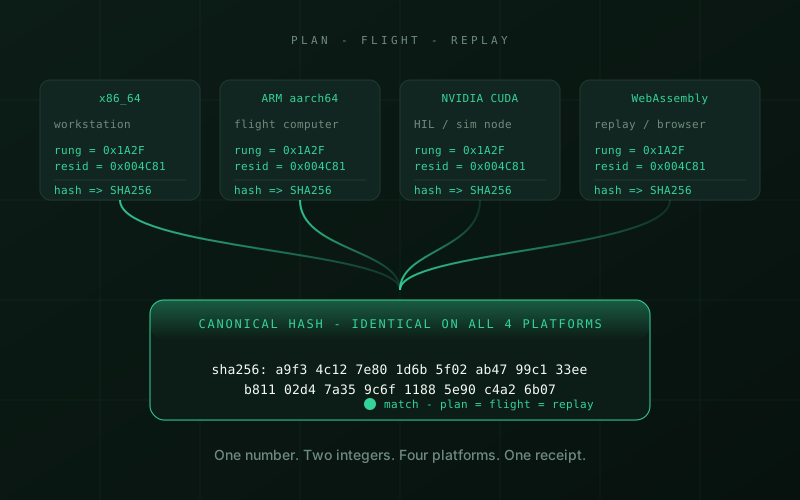
Mission orders are approved on one machine, executed on another, and replayed on a third — and the numbers have to be the same. SolvNum is a deterministic real-number primitive that produces bit-identical arithmetic across x86, ARM, NVIDIA GPU, and WebAssembly. One SHA-256 receipt proves plan = flight = replay. A cross-target equivalence argument that fits on one line of a DO-178C / ISO 26262 certification package.
SolvNum
Program Audit & Acceptance
Solver decisions that survive a program-office review
Every numerical claim on this site traces back to a test, a seed, and a verdict in our internal evidence register. The same standard travels with the products you buy: SolvScout fingerprints your system and ranks every candidate solver with dead zones called out, and SolvBench archives the decision in an encrypted, replayable profile — so “why this solver?” has a defensible answer at TRR, milestone audit, and Section 818 review.
SolvScoutSolvBenchSolvNum
Have a specific program in mind?
We engage under appropriate agreements (NDA, ITAR-aware, and Canadian Controlled Goods where applicable). Briefs are short, technical, and respectful of your time.
The defense product line on top of one computational engine.
Each product brief below opens with a scenario, then walks through what it is, who uses it, why it’s defensible, and how the underlying claims survive an audit.
Solver
SolvSRK for GN&C and Embedded Flight Math
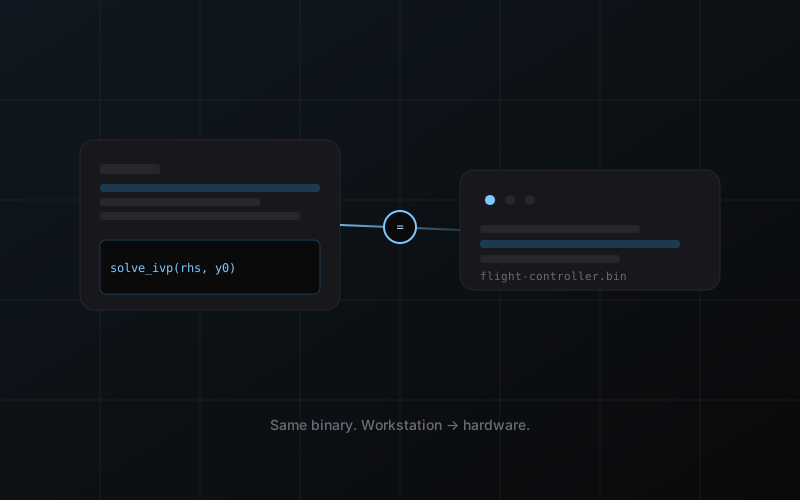
Same binary. Workstation, HIL rig, airframe.
GN&C engineers spend years closing the gap between the solver that worked in simulation and the solver that ships on the flight computer. SolvSRK is one C-native solver that runs in both places with identical behavior — survives contested sensor data, fits inside ITAR-compliant airgapped pipelines, and produces bit-identical digital twins where divergence means a real fault, not a software artifact.
Solver
SolvSRK-UQ for Autonomy and Mission Confidence
Controllers that know how confident they are.
Autonomous platforms carry one fixed safety margin — the worst case under the noisiest sensor data. SolvSRK-UQ tracks state-space uncertainty inside the solve and exposes it as a control signal, so the autopilot tightens when the picture is clean and backs off when it isn’t. Delivers calibrated uncertainty envelopes from a single solve — fast enough for the autopilot, the operator console, or the certification harness.
Solver
SolvFilter for Multi-Target Tracking
140-state EKF predict that survives where scipy fails.
Counter-UAV and fleet tracking stacks need Riccati prediction at scale on embedded processors. At dim=140, scipy EKF predict survives 0/280 cells; UKF cost dominates. SolvFilter delivers 140/140 survival, 74× lower cost than UKF, and best NEES consistency — SF-3 CONFIRMED.
Solver
SolvNum — Deterministic Arithmetic for Mission Software
Plan, flight, and replay agree to the bit.
Today the mission you approved on the screen, the mission the platform actually flew, and the mission the incident-review team replays in the lab are three slightly different sets of numbers — because they ran on three different computers. SolvNum is a deterministic real-number primitive that produces bit-identical arithmetic across x86, ARM, NVIDIA GPU, and WebAssembly. One SHA-256 receipt proves plan = flight = replay.
Library
Moridain for Mission Data Links
Recover the intelligence the link compression throws away.
Tactical data links — Link-16, CDL, contested low-bandwidth comms — compress a rich sensor picture down to a tiny standardized message before it reaches the consumer. Moridain sits on the network side, extracts bounded intelligence signals from the full upstream picture, and delivers them inside the existing message envelope. Validated on a 590,540-event benchmark with 5-fold cross-validation.
Developer tool
SolvScout
Pick the right solver — with evidence the auditor accepts.
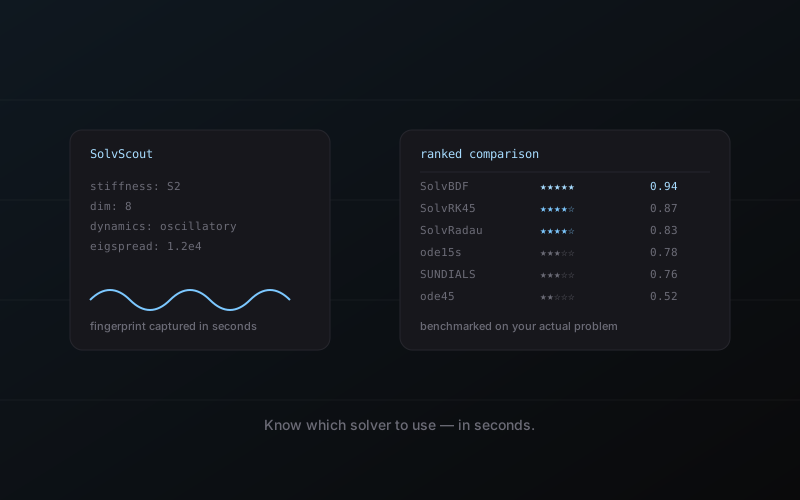
SolvScout fingerprints your ODE system, benchmarks every candidate solver against it, and produces a ranked, dead-zone-honest comparison report. Drop-in replacement for the “we picked it because the senior engineer used it in 2008” conversation that does not survive the next program review.
Developer tool
SolvBench
Mission control for the math inside your simulation.
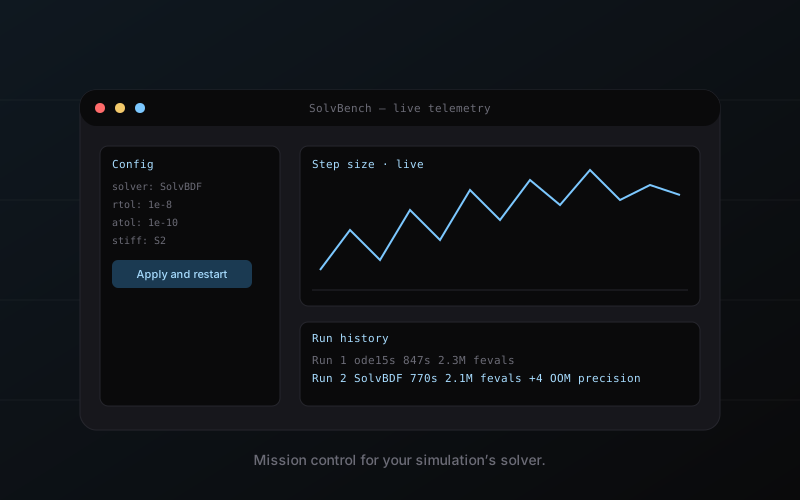
The desktop application that turns solver selection from guesswork into evidence. SolvBench orchestrates Scout, Tune, and the SolvEngine runtime — characterize the system, benchmark the candidates, apply the winning configuration, watch the solver work in real time, and archive every decision in an encrypted profile database the auditor can replay.
Platform
Inside the Lab
How we earn the right to make every claim on this site.
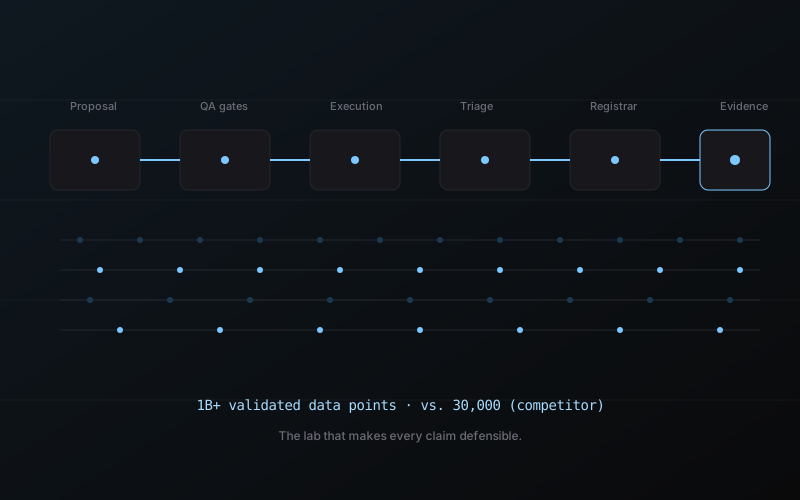
Every benchmark, every dead zone, every survival number on this site came out of an AI-orchestrated research lab we built to validate our own solver. One engineer. Six weeks to stand up. Over 5.29 trillion state-space samples, 1 billion validated data points (the nearest credible competitor has 30,000), 1.1 trillion function evaluations, and zero retracted findings.
Engagement model
Built for programs that have to survive audit.
ITAR-aware. Airgapped delivery available for classified work. Compile-time license — no phone-home, no telemetry, no surprise dependencies. Every numerical claim traces back to a test ID, a seed, and a verdict in a live evidence register.